Why justice is delayed in India is a question that affects millions of citizens navigating the legal system today.
India’s justice system stands at a crucial juncture.
While the principles of justice are deeply rooted in the Constitution—ensuring equality before law, fair trials, and protection of rights—the real challenge lies in execution.
For a common citizen, accessing justice is often slow, complex, and uncertain.
This gap between law and reality explains why justice is delayed in India and why the system needs urgent strengthening.
Quick Overview: Why Justice is Delayed in India
Several structural challenges explain why justice is delayed in India:
- Over 50 million pending cases across courts
- Cases taking years—even decades—to resolve
- Estimated ~2% GDP loss annually due to legal delays
- A large number of issues never even enter the system
The problem doesn’t begin in courts—it starts much earlier.
The Core Problem: Barriers at Every Stage
The reasons why justice is delayed in India go beyond judicial backlog.
Inefficiencies exist across all stages:
- Reporting – citizens don’t file complaints
- Investigation – limited resources and inefficiencies
- Judicial process – delays and procedural complexity
Together, these barriers make justice difficult to access.
Stage 1: The Biggest Barrier — Taking the First Step
One of the most critical reasons why justice is delayed in India:
Most people never report their issue.
- Nearly 90% of victims do not file complaints
- Millions of cases go unreported every year
Why This Happens
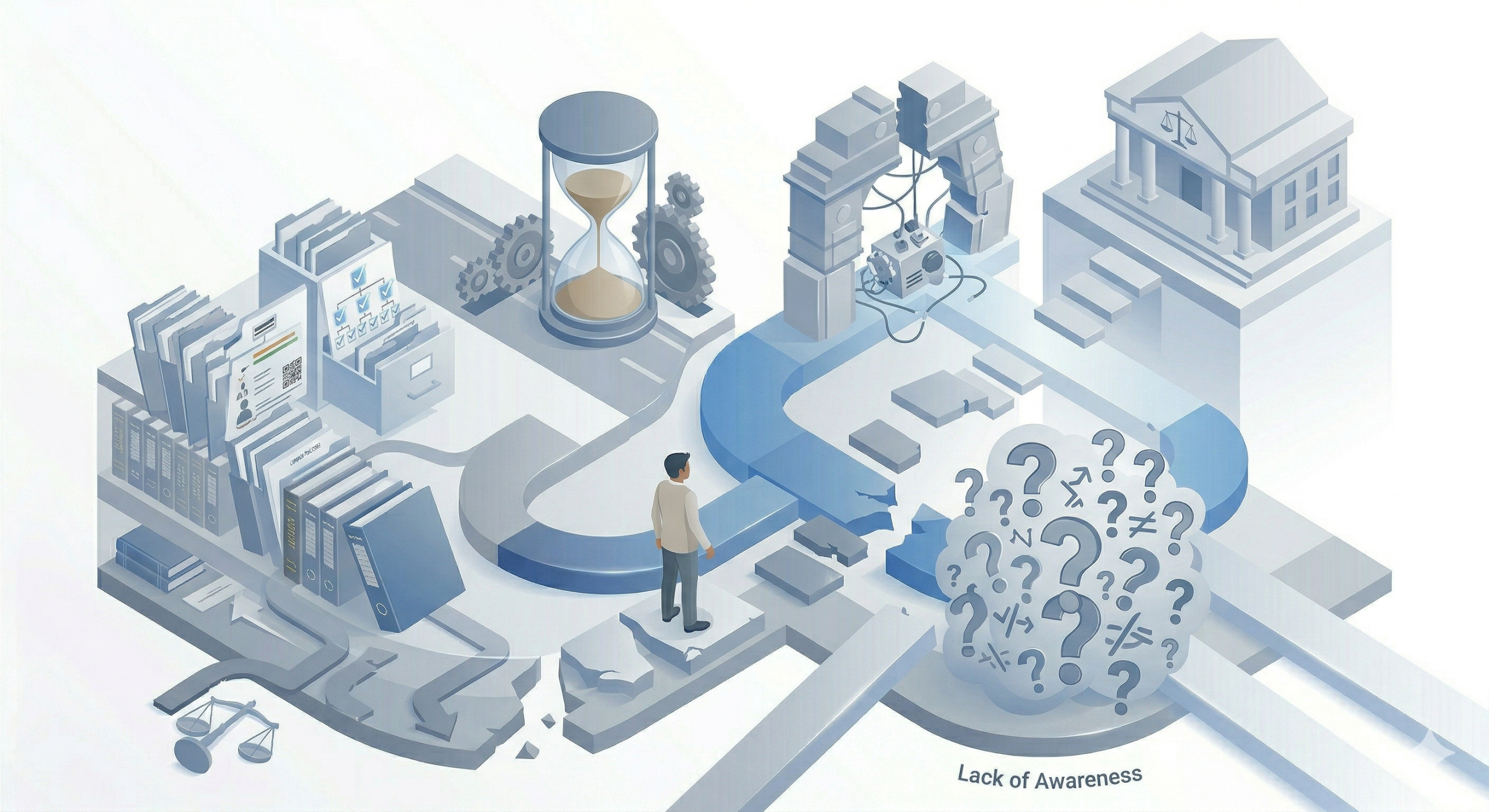
1. Lack of Awareness
People are unsure:
- Whether their issue is legally actionable
- What their rights are
- Where to go
2. Perceived Low Value
“It’s too much effort for such a small issue”
This leads to inaction instead of resolution.
3. Lack of Trust in the System
- Fear of delays
- Belief that nothing will happen
- Past negative experiences
4. Fear of Consequences
- Retaliation
- Social pressure
- Getting stuck in long processes
This silence leads to underreporting and systemic inefficiency.
Stage 2: Weak Foundations — Poor Complaint Quality
Even when people act, another issue arises:
Poorly drafted complaints
Common problems:
- Missing key facts
- Lack of evidence
- No clarity
- Filed with the wrong authority
Why This Matters
A complaint is not just a document—it is the foundation of the legal process.
Weak complaints lead to:
- Delayed FIRs
- Ineffective investigations
- Weak prosecution
👉 If you’re unsure how to structure a complaint, read this guide:
https://simplertoday.ai/how-to-file-a-cybercrime-complaint-online-in-india/
Stage 3: Investigation Challenges
Law enforcement agencies face:
- Shortage of personnel
- High workload
- Administrative delays
- Increasing case complexity
Combined with weak complaints, this results in:
- Slower investigations
- Reduced efficiency
- Delayed justice
Stage 4: Judicial Delays and Case Backlog
Once cases reach courts:
- Massive case backlog
- Procedural complexity
- Multiple hearings and adjournments
Result:
- Cases take years to resolve
- Emotional and financial burden increases
- Public trust declines
The Systemic Cycle of Delay
These issues create a self-reinforcing cycle:
- People don’t report → crimes go unaddressed
- Weak complaints → slow investigations
- Delays → loss of trust
- Loss of trust → further underreporting
This cycle explains why justice is delayed in India at a systemic level.
Solutions: How to Improve Access to Justice
Solving why justice is delayed in India requires more than legal reform.
We need:
- Better legal awareness
- Simpler entry points for citizens
- Clear step-by-step guidance
- Structured documentation
- Faster early-stage processes
The goal is not just better laws—but better usability.
You can also explore government-backed legal aid services through the
National Legal Services Authority (NALSA).
Where Simpler Today Helps
Simpler Today is designed to bridge the gap between legal awareness and action.
- Understand your situation clearly
- Know the right steps to take
- Get a structured consultation report
- Move forward with confidence
👉 Start here: https://simplertoday.ai/
Or connect directly:
- Call/WhatsApp: +91 8048795197
- Email: [email protected]
Frequently Asked Questions
Why is justice delayed in India?
Due to multiple factors including underreporting, weak complaints, investigation challenges, and court backlog.
How many cases are pending in India?
There are over 50 million pending cases across courts.
What is the biggest reason for legal delays?
The biggest issue is that many cases never even enter the system due to lack of awareness and trust.
How can the system improve?
By simplifying access, improving documentation, and guiding citizens effectively from the start.
Conclusion
India’s justice system is built on strong principles—but its effectiveness depends on accessibility.
Understanding why justice is delayed in India reveals that the biggest challenge isn’t just court delays—it’s the difficulty of taking the first step correctly.
When citizens are empowered with clarity, guidance, and the right tools, the entire system becomes more efficient.
And that’s where real change begins.