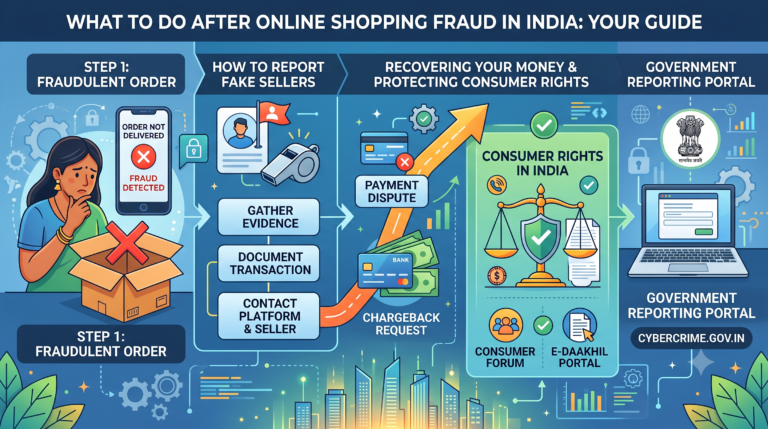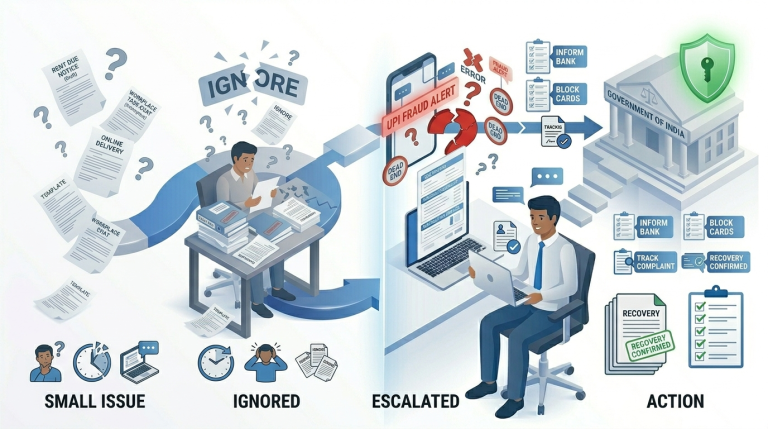
Cyber fraud has become one of the fastest growing crimes in India. Every day, thousands of people lose money through UPI scams, phishing links, fake investment schemes, remote access apps, and identity theft.If you become a victim, the first few hours are critical. Acting quickly can improve the chances of tracing the transaction, freezing funds, and supporting the investigation.
This guide explains how to file a cyber crime complaint online in India, what documents you should keep ready, and the steps you should take immediately after discovering the fraud.
Table of Contents
Step 1. Contact Your Bank Immediately
If the fraud involves your bank account, debit card, credit card, or UPI account, your first priority should be to inform your bank.
Contact the bank through its official customer care number, mobile banking app, or branch.
Request the bank to:
- Block the affected account or card if necessary.
- Freeze the beneficiary account, where possible.
- Raise a dispute for the fraudulent transaction.
- Provide you with a complaint or reference number.
Reporting the fraud immediately gives the bank a better opportunity to respond before the funds are moved further.
Step 2. Report the Fraud Through the National Cyber Crime Reporting Portal
The Government of India allows victims to report cyber crimes online through the National Cyber Crime Reporting Portal.
Official Website:
If the fraud involves financial transactions, you should also call the national cyber fraud helpline 1930 as soon as possible.
When filing the complaint, provide complete and accurate information to help the authorities understand the incident.
Step 3. Gather All Supporting Evidence
Before submitting your complaint, collect every document related to the fraud.
Keep copies of:
- Bank statements.
- UPI transaction details.
- Transaction IDs.
- SMS alerts.
- Emails.
- Screenshots.
- Fraudulent phone numbers.
- UPI IDs or account numbers used by the fraudster.
- WhatsApp conversations or messages.
- Any other communication related to the incident.
Well-organised evidence helps the investigating authorities understand the case more efficiently.
Step 4. Prepare a Clear Complaint
Many complaints are delayed because important information is missing.
A good complaint should clearly explain:
- What happened.
- When the fraud occurred.
- How the fraud was committed.
- The amount involved.
- The available evidence.
- The action already taken with the bank.
A structured complaint reduces confusion and supports faster processing.
Step 5. Visit the Cyber Crime Police Station, If Required
Depending on the circumstances, you may also be asked to visit the nearest Cyber Crime Police Station or local police station.
Carry:
- Identity proof.
- A copy of your complaint.
- Supporting documents.
- Bank acknowledgement.
- Complaint reference number.
In appropriate cases, you may also be able to lodge a Zero FIR, allowing the complaint to be registered even if the incident occurred outside the local jurisdiction.
Step 6. Track Your Complaint
After submitting your complaint, keep a record of the acknowledgement number or complaint reference.
Use this information while following up with:
- Your bank.
- The investigating officer.
- The cyber crime authorities.
Maintaining proper records helps ensure smoother communication during the investigation.
What Are Your Rights?
If you become the victim of cyber fraud, you have important legal rights.
These include:
- The right to report the incident.
- The right to receive an acknowledgement of your complaint.
- The right to approach the appropriate police authorities.
- The right to pursue further legal remedies where applicable.
Understanding your rights allows you to respond with greater confidence during a stressful situation.
Common Mistakes That Delay Recovery
Many victims unintentionally reduce their chances of recovery by making avoidable mistakes.
The most common include:
1. Waiting Too Long
Fraudsters often move stolen funds rapidly through multiple accounts.
Early reporting is essential.
2. Deleting Messages
Never delete SMS alerts, emails, or WhatsApp conversations related to the fraud.
3. Contacting Fake Customer Care Numbers
Always use the official contact details available on your bank’s website or mobile application.
4. Filing Incomplete Complaints
Missing transaction IDs, incorrect dates, or incomplete timelines may delay the investigation.
How SimplerToday Can Help
If you’ve experienced cyber fraud, understanding the correct sequence of actions can make a significant difference.
At SimplerToday, we help individuals organise the facts of their case, understand the available legal options, and prepare structured documentation before taking further action.
The process includes:
1. Share Your Situation
Explain what happened through a phone call or WhatsApp.
2. Initial Review
A qualified legal professional reviews your information and identifies any missing details.
3. Receive Your First Consultation Report
Depending on your circumstances, the report may include:
- Suggested next steps.
- Missing information.
- Applicable legal provisions.
- Jurisdiction.
- Key strengths and possible risks.
The aim is to help you respond quickly and make informed decisions.
Watch: Decoding India’s Cyber Crime Crisis
To better understand how cyber fraud works, why recovery becomes difficult, and the legal and practical challenges victims face, watch this in-depth discussion featuring Mr. Amit Shukla and Prof. Pankaj Bafna.
The conversation explores:
- How cyber fraud networks operate.
- Common mistakes victims make.
- The role of banks and law enforcement.
- Practical steps that improve the chances of recovery.
You can watch the full discussion here:
“Decoding India’s Cyber Crime: An Exclusive Conversation with Prof. Pankaj Bafna”
Official Resources
For reporting cyber crime and accessing government information, you can refer to:
- National Cyber Crime Reporting Portal
https://cybercrime.gov.in - Reserve Bank of India – Consumer Awareness
https://www.rbi.org.in - Indian Cyber Crime Coordination Centre (I4C)
https://i4c.mha.gov.in
Frequently Asked Questions
1. How do I file a cyber crime complaint online in India?
You can report cyber crimes through the National Cyber Crime Reporting Portal by submitting the incident details and supporting documents. For financial fraud, you should also contact your bank immediately and call the cyber fraud helpline 1930.
2. Can money be recovered after cyber fraud?
Recovery is possible in some cases, particularly when the fraud is reported promptly and the relevant authorities are able to trace or freeze the movement of funds. However, recovery depends on the facts of each case and cannot be guaranteed.
3. What documents should I keep before filing a complaint?
Keep transaction IDs, bank statements, screenshots, SMS alerts, emails, payment confirmations, and any communication related to the fraud.
4. Can I report cyber fraud from another city?
Yes. Depending on the circumstances, you may also be able to lodge a Zero FIR, allowing the complaint to be registered even if the incident occurred outside the local jurisdiction.
5. How quickly should I report cyber fraud?
Immediately. Early reporting improves the chances of tracing transactions and supporting recovery efforts.
Conclusion
Knowing how to file a cyber crime complaint online in India can make a significant difference when you’re faced with financial fraud or another cyber offence.
The key is to act without delay. Contact your bank, preserve every piece of evidence, report the incident through the appropriate government channels, and maintain complete records throughout the process.
Taking prompt and well-documented action gives you the best opportunity to protect your interests and support the investigation.