Lending money to a friend, relative, business partner, or acquaintance often begins with trust. Unfortunately, many people find themselves searching for answers when that trust is broken and the money is never returned.
If someone refuses to return money that you gave them, you may feel frustrated, unsure of your rights, or worried that you have no legal remedy, especially if there wasn’t a formal agreement.
The good news is that not every money recovery dispute ends in court. In many cases, timely action, proper documentation, and the right legal approach can help resolve the matter.
This guide explains what you should do if someone refuses to return your money in India.
Table of Contents
Can You Legally Recover Money Lent to Someone?
Yes. In many situations, money that has been lent can be recovered through legal remedies, provided there is enough evidence to support the claim.
Evidence doesn’t always mean a written loan agreement. Depending on the facts, it may include:
- Bank transfer records.
- UPI payment history.
- WhatsApp conversations.
- Emails.
- SMS messages.
- Witnesses.
- Written acknowledgements of the debt.
The stronger your documentation, the easier it becomes to establish your claim.
What Should You Do First?
Before taking legal action, avoid making emotional decisions.
Instead, follow these practical steps.
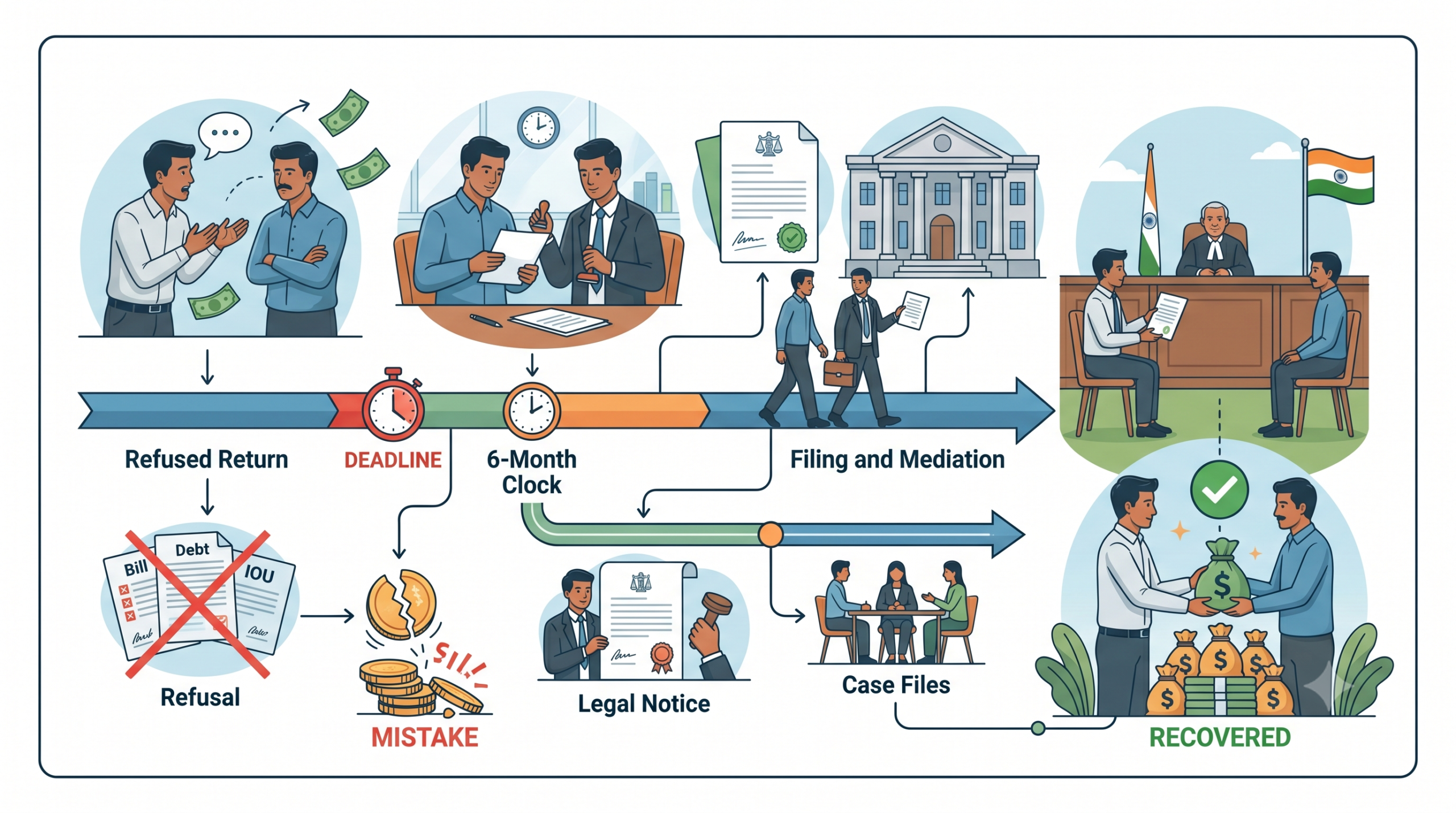
1. Collect All Available Evidence
Gather every document that proves the transaction took place.
This may include:
- Bank statements.
- UPI transaction history.
- Payment receipts.
- Screenshots of conversations.
- Emails.
- Voice recordings, where legally permissible.
- Any written promise to repay.
Even informal communication can become important evidence later.
2. Speak to the Person Calmly
Sometimes disputes arise because of misunderstandings or temporary financial difficulties.
Before escalating the matter, try to communicate politely and clearly.
Keep all communication in writing wherever possible.
Avoid threats, abusive language, or repeated harassment, as these may create additional legal complications.
3. Send a Written Reminder
If verbal requests are ignored, send a clear written reminder asking for repayment.
Mention:
- The amount due.
- The date the money was given.
- Any previous conversations.
- A reasonable deadline for repayment.
Written communication creates an important record of your efforts to resolve the matter.
When Should You Send a Legal Notice?
If repeated reminders do not result in repayment, sending a legal notice may be the next appropriate step.
A legal notice formally communicates:
- The facts of the dispute.
- The amount claimed.
- The legal basis of your claim.
- The time allowed for repayment.
- The action that may follow if the matter remains unresolved.
Many disputes are settled after a properly drafted legal notice because it shows that the lender is serious about pursuing the matter.
What If There Was No Written Agreement?
Many people believe they cannot recover money without a signed agreement.
That is not always true.
Courts may consider several types of evidence, including:
- Digital payment records.
- WhatsApp chats.
- Emails.
- Audio or written acknowledgements.
- Witness testimony.
Each case depends on its own facts, so preserving every available piece of evidence is important.
Can You File a Court Case?
If the dispute cannot be resolved through communication or a legal notice, legal proceedings may be an option.
The appropriate remedy depends on factors such as:
- The amount involved.
- The nature of the transaction.
- The available evidence.
- The relationship between the parties.
A legal professional can help determine the most suitable course of action based on your circumstances.
Common Mistakes That Reduce Your Chances of Recovery
Many people unintentionally weaken their own case.
Some of the most common mistakes include:
1. Waiting Too Long
Delays can make collecting evidence and proving the transaction more difficult.
2. Accepting Cash Without Records
Whenever possible, use traceable payment methods and retain proof of payment.
3. Deleting Messages
Never delete WhatsApp chats, emails, or payment confirmations related to the transaction.
4. Making Verbal Agreements Only
Even a simple written acknowledgement can prevent future disputes.
5. Using Threats or Harassment
Taking the law into your own hands may create additional legal issues.
Always follow lawful methods for recovery.
Real Life Example
Rahul transferred ₹2 lakh to a friend to help him expand a small business.
The friend promised to repay the amount within six months.
After several months, repayment stopped completely. Phone calls were ignored, and verbal assurances continued without any actual payment.
Fortunately, Rahul had:
- Bank transfer records.
- WhatsApp conversations discussing the loan.
- Messages acknowledging the amount due.
Instead of relying on repeated verbal requests, he organised the available evidence, sent formal written communication, and sought legal guidance regarding the next steps.
The dispute moved from uncertainty to a structured recovery process.
How SimplerToday Can Help
If someone has refused to return your money, understanding your legal options early can help you avoid unnecessary delays.
At SimplerToday, we help individuals organise the facts of their dispute and understand the appropriate next steps.
The process is straightforward.
1. Share Your Situation
Explain what happened through a phone call or WhatsApp. You don’t need to use legal language.
2. Initial Legal Review
A qualified legal professional reviews the available information, identifies any missing details, and assesses the legal position.
3. Receive Your First Consultation Report
Depending on your situation, the report may include:
- Suggested next steps.
- Missing information.
- Applicable legal provisions.
- Jurisdiction.
- Key strengths and possible risks.
The objective is to help you make informed decisions before taking further legal action.
Read our guide – https://simplertoday.ai/how-online-legal-guidance-works-in-india/
Official Resources
For additional legal information, you can refer to:
- Department of Justice
https://doj.gov.in - eCourts Services
https://services.ecourts.gov.in - National Legal Services Authority (NALSA)
https://nalsa.gov.in
Frequently Asked Questions
1. Can I recover money that I lent without a written agreement?
Yes, depending on the available evidence. Bank transfers, UPI records, emails, WhatsApp messages, and other communications may help establish your claim.
2. Should I send a legal notice before filing a case?
In many disputes, a legal notice is an effective first step. It provides the other party with an opportunity to resolve the matter before legal proceedings are considered.
3. Can I recover money transferred through UPI?
Digital payment records may serve as important evidence. Whether recovery is possible depends on the facts of the case and the available documentation.
4. What if the other person keeps making excuses?
If repeated requests have not resulted in repayment, it may be appropriate to seek legal guidance and consider the available legal remedies.
5. How long should I wait before taking legal action?
There is no single answer for every case, but unnecessary delays can weaken your position. It’s generally advisable to document the matter and seek guidance as soon as it becomes clear that repayment is being avoided.
Conclusion
When someone refuses to return your money, it can feel like you’ve run out of options. However, many disputes can be addressed effectively by acting early, preserving evidence, and following the appropriate legal process.
Rather than relying on repeated verbal requests or informal promises, focus on documentation, clear communication, and timely action. Taking the right steps at the right time can significantly improve your ability to resolve the dispute and protect your financial interests.