Ending a marriage is never an easy decision. However, when both spouses agree that the relationship has broken down and wish to separate peacefully, mutual divorce is often the quickest and least stressful legal option available.
Many couples searching for the mutual divorce process in India have similar questions.
How long does the process take?
Can mutual divorce be filed online?
What documents are required?
How much does it cost?
Is the six month waiting period compulsory?
This guide answers these questions in simple language and explains the complete mutual divorce process from start to finish.
Table of Contents
What Is Mutual Divorce?
Mutual divorce, also known as divorce by mutual consent, is a legal process where both spouses jointly decide to end their marriage.
Instead of blaming each other or contesting the divorce, both parties agree on important issues such as:
- Division of property.
- Child custody and visitation.
- Alimony or maintenance.
- Any other financial settlements.
Since both spouses agree on these matters, the process is generally faster than a contested divorce.
Who Can Apply for Mutual Divorce?
Under Indian law, couples can generally file for mutual divorce if certain conditions are satisfied.
These usually include:
- Both spouses voluntarily agree to dissolve the marriage.
- They believe the marriage has broken down beyond repair.
- They have mutually agreed on issues relating to children, finances, and property wherever applicable.
The exact legal requirements may vary depending on the personal law governing the marriage.
Documents Required for Mutual Divorce
Before filing the petition, keep the following documents ready.
- Marriage certificate, if available.
- Identity proof such as Aadhaar Card, Passport, or PAN Card.
- Address proof of both spouses.
- Passport size photographs.
- Marriage photographs, if required.
- Proof of residence.
- Income details or salary documents, where relevant.
- Details regarding children, if any.
- Settlement agreement covering property, maintenance, and custody.
Having complete documentation helps avoid unnecessary delays during the court process.
Step by Step Mutual Divorce Process in India
Understanding each stage of the process makes it easier to know what to expect.
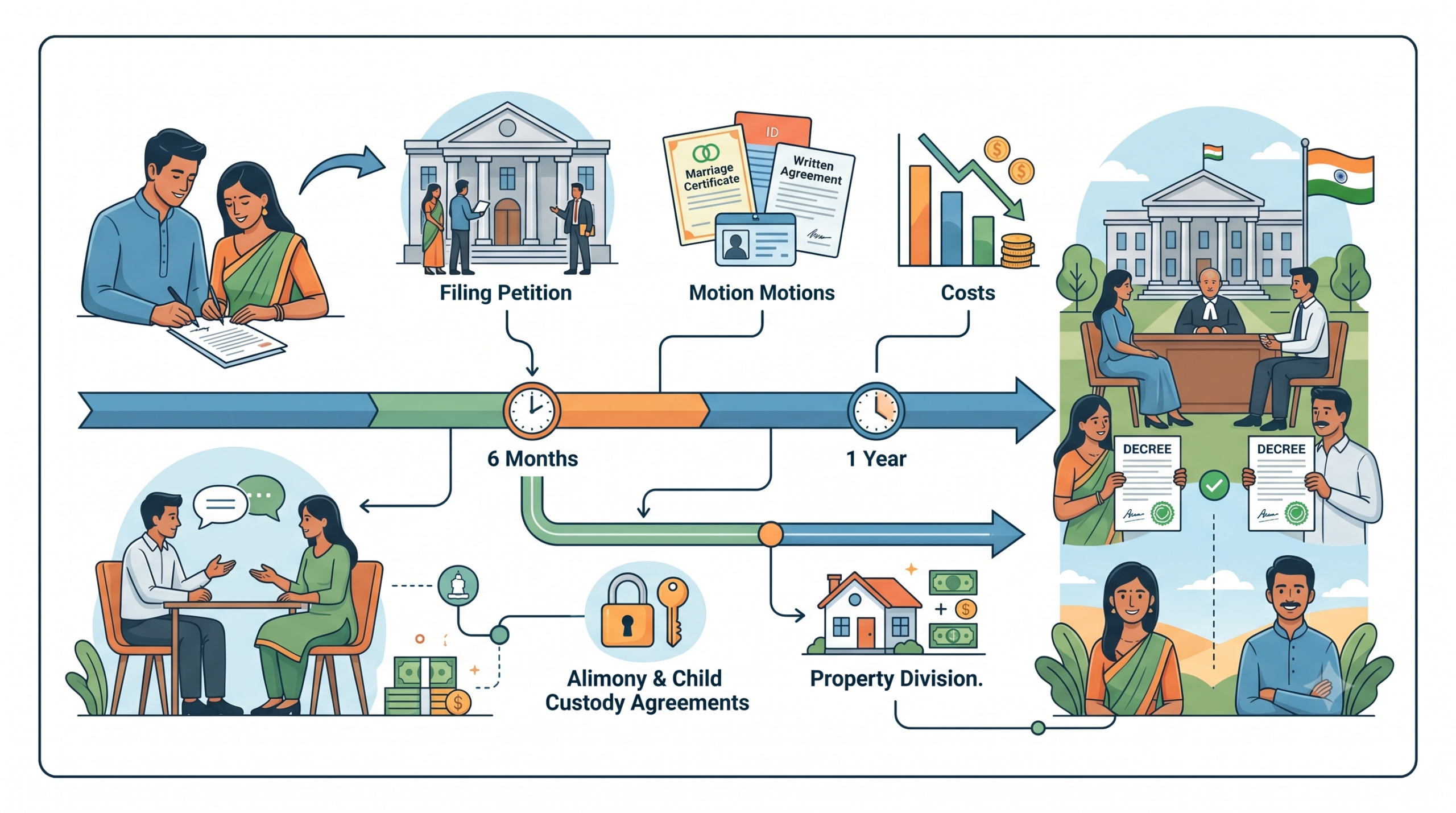
Step 1. Decide the Terms of Settlement
Before approaching the court, both spouses should discuss and agree on important issues.
These generally include:
- Alimony or maintenance.
- Child custody.
- Visitation rights.
- Division of assets and liabilities.
- Return of jewellery, gifts, or other belongings.
A clear settlement reduces future disputes.
Step 2. Prepare the Joint Divorce Petition
After reaching an agreement, a joint petition is prepared and signed by both spouses.
The petition contains details about:
- The marriage.
- The reasons for seeking divorce.
- The settlement agreed upon.
Step 3. File the Petition Before the Family Court
The petition is filed before the appropriate Family Court having jurisdiction over the matter.
The court verifies the documents and schedules the first hearing.
For information about courts and case status, you can visit the official eCourts Services Portal.
External Resource: https://services.ecourts.gov.in
Step 4. First Motion
Both spouses appear before the court.
The judge records their statements and confirms that the consent has been given voluntarily.
If satisfied, the court accepts the first motion.
Step 5. Cooling Off Period
Traditionally, a waiting period follows the first motion to give the couple time to reconsider their decision.
However, depending on the facts of the case and judicial precedents, courts may waive this period in appropriate circumstances.
Step 6. Second Motion
After the applicable waiting period, both spouses appear before the court again to confirm that they still wish to proceed with the divorce.
The court reviews the settlement and records the final statements.
Step 7. Final Divorce Decree
If the court is satisfied that all legal requirements have been fulfilled, it grants a decree of divorce.
Once the decree is passed, the marriage is legally dissolved.
How Long Does Mutual Divorce Take?
The timeline depends on several factors, including:
- The court’s schedule.
- Whether all documents are complete.
- Whether both spouses continue to consent throughout the process.
- Whether the waiting period is waived.
Cases where both parties cooperate generally move much faster than contested divorce proceedings.
What Is the Cost of Mutual Divorce?
The total cost varies depending on factors such as:
- Lawyer’s professional fees.
- Court related expenses.
- Complexity of the settlement.
- Number of hearings required.
It is advisable to discuss all expected costs before beginning the process.
What Happens to Child Custody?
If the couple has children, both spouses should mutually decide matters relating to:
- Physical custody.
- Visitation rights.
- Educational expenses.
- Financial support.
The court always considers the welfare of the child while reviewing custody arrangements.
What About Alimony and Maintenance?
Alimony is not automatically payable in every mutual divorce.
The spouses may mutually agree on:
- A one time settlement.
- Monthly maintenance.
- No maintenance, if both parties agree and the arrangement is legally acceptable.
The final settlement should be clearly documented in the joint petition.
Can Mutual Divorce Be Filed Online?
Some parts of the process, such as consultations, document preparation, and communication with legal professionals, can be completed online.
However, depending on the applicable rules and court procedures, personal appearances before the Family Court may still be required.
Common Mistakes to Avoid
Many couples unintentionally delay the process by making avoidable mistakes.
Some of the most common are:
- Filing the petition before reaching a complete settlement.
- Leaving financial terms unclear.
- Ignoring child custody arrangements.
- Submitting incomplete documents.
- Not seeking proper legal guidance before filing.
How SimplerToday Can Help
If you’re considering mutual divorce and want to understand your options before starting the legal process, SimplerToday provides structured legal guidance to help you make informed decisions.
The process is simple.
1. Share Your Situation
Explain your circumstances through a phone call or WhatsApp. No legal terminology is required.
2. Initial Legal Review
A qualified legal professional reviews your situation, understands the key facts, and identifies the legal issues involved.
3. Receive Your First Consultation Report
Depending on your case, the report may include:
- Suggested next steps.
- Missing information.
- Applicable legal provisions.
- Jurisdiction.
- Key strengths and possible risks.
The aim is to help you understand your legal position before taking further action.
Official Resources
For additional information, you can refer to these official websites.
- eCourts Services Portal
https://services.ecourts.gov.in - Department of Justice
https://doj.gov.in - National Legal Services Authority (NALSA)
https://nalsa.gov.in
Frequently Asked Questions
1. What is mutual divorce?
Mutual divorce is a legal process in which both spouses jointly agree to dissolve their marriage and settle issues such as property, maintenance, and child custody.
2. How long does mutual divorce take in India?
The duration depends on the facts of the case, court schedules, and whether the applicable waiting period is waived.
3. Is a lawyer compulsory for mutual divorce?
While legal representation is not mandatory in every situation, professional guidance can help ensure that documents are correctly prepared and the process runs smoothly.
4. Can one spouse withdraw consent?
Yes. Mutual divorce requires the consent of both spouses until the court grants the final decree. If one spouse withdraws consent before the decree is passed, the mutual divorce petition may not proceed.
5. Can mutual divorce be completed entirely online?
Certain stages, such as consultations and document preparation, can often be completed online. However, court appearances may still be required depending on the applicable legal procedure.
Conclusion
Mutual divorce offers couples a more cooperative and less adversarial way to end a marriage when both spouses have decided to move forward separately.
Understanding the legal process, preparing the necessary documents, and resolving important issues in advance can make the journey smoother and reduce unnecessary delays.
If you’re unsure about your legal options or the procedure applicable to your situation, seeking legal guidance at an early stage can help you make informed decisions with greater confidence.