Table of Contents
Introduction
Most people think the damage is done the moment money leaves their bank account.
That is not always true.
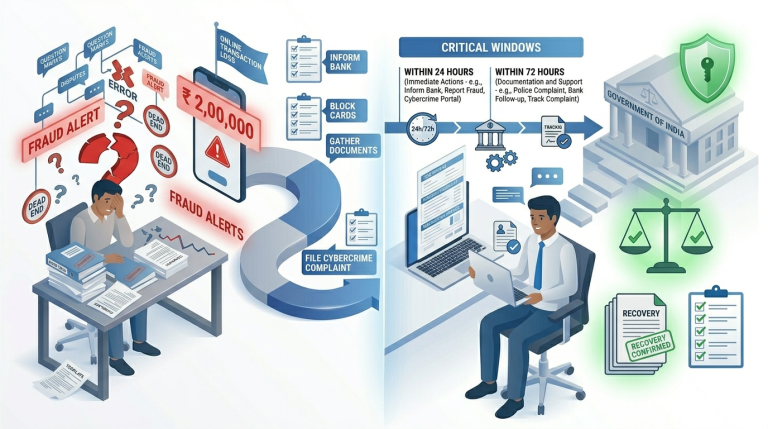
What you do in the next few minutes can have a direct impact on whether the money can be traced, frozen, or recovered. Every minute matters because fraudsters often move stolen funds through multiple bank accounts before withdrawing them.
Whether you received a fake KYC call, approved a fraudulent UPI request, clicked a phishing link, or shared an OTP with someone pretending to be from your bank, acting quickly gives you the best chance of limiting the loss.
This guide explains exactly what to do after a cyber fraud in India, the order in which you should act, and the documents you should keep ready.
Why the First 30 Minutes Matter
Many victims spend valuable time trying to understand what happened or arguing with the caller who cheated them.
Unfortunately, that delay often works in the fraudster’s favour.
As soon as money is transferred, it may pass through several accounts within minutes. Once withdrawn or moved repeatedly, recovering it becomes much more difficult.
Taking immediate action helps in several ways.
- Your bank may be able to block or flag the transaction.
- The beneficiary account may be frozen before the funds are withdrawn.
- The cyber crime authorities can begin tracking the money trail sooner.
- Your complaint creates an official record that may support future recovery or legal proceedings.
The first thirty minutes are often more important than the next three days.
Never Share These Banking Details
Cyber criminals succeed because they create urgency. They may claim your account will be blocked, your KYC has expired, or your mobile number has been linked to illegal activity.
Remember one simple rule.
No bank, government department, RBI official, police officer, or genuine customer support executive will ask you for the following over a phone call, WhatsApp message, email, or SMS.
- OTP
- UPI PIN
- ATM PIN
- CVV
- Net banking password
- Debit or credit card details
- Permission to install screen sharing applications
If someone asks for any of these details, end the conversation immediately and contact your bank using its official customer care number.
What Should You Do Immediately After a Cyber Fraud?
Step 1. Contact Your Bank Immediately
Your first call should always be to your bank.
Use the customer care number available on the bank’s official website, mobile application, passbook, or debit card. Avoid calling any number received through an SMS, social media post, or search result unless you have verified that it is genuine.
Ask the bank to take the following actions immediately.
- Block your debit or credit card if required.
- Freeze or restrict your account where necessary.
- Attempt to stop or reverse the transaction.
- Disable internet banking or UPI access if there is a risk of further misuse.
- Give you a complaint or reference number.
Before ending the call, ask the bank to send confirmation through email or SMS. This acknowledgment may be useful later.
Step 2. Submit a Written Complaint to the Bank
A phone call is only the beginning. You should also submit a written complaint as soon as possible.
A written complaint creates an official record and strengthens your position if you later need to approach the RBI Ombudsman, a consumer forum, or another authority.
Attach copies of the following documents wherever possible.
- Transaction details or bank statement.
- Screenshots of messages or emails.
- Call logs or WhatsApp conversations.
- Transaction ID or UTR number.
- Identity proof.
If you are submitting the complaint at a branch, carry two copies and ask the bank to stamp one copy as proof of receipt.
Step 3. Report the Fraud Through the National Cyber Helpline
After informing your bank, immediately report the incident by calling 1930.
You should also submit a complaint through the National Cyber Crime Reporting Portal.
Link: https://cybercrime.gov.in
While filing the complaint, keep the following information ready.
- Bank account details.
- Transaction amount.
- Date and time of the transaction.
- Screenshots of messages or payment confirmations.
- Complaint number received from your bank.
Quick reporting improves the chances of tracing the money before it moves further through the banking system.
Step 4. File a Police or Cyber Cell Complaint
Visit your local police station or the nearest cyber crime police station with all relevant documents.
Carry the following.
- Copy of your bank complaint.
- Cyber crime complaint acknowledgment.
- Transaction details.
- Identity proof.
- Screenshots and other evidence.
A police complaint becomes important if the matter later involves recovery proceedings, insurance claims, criminal investigation, or legal action.
Common Cyber Frauds in India
The methods used by cyber criminals continue to evolve, but some frauds appear repeatedly.
1. Fake KYC Verification
Scammers claim your account or mobile number will be blocked unless you update your KYC immediately.
2. UPI and OTP Frauds
Victims are persuaded to share an OTP or approve a payment request while believing they are receiving money.
3. Screen Sharing Scams
Fraudsters convince victims to install remote access applications, allowing them to control banking apps on the victim’s device.
4. Fake Customer Care Numbers
Fake support numbers are published online to target people searching for urgent banking assistance.
5. Investment Scams
Promises of guaranteed returns, stock market profits, cryptocurrency gains, or exclusive investment opportunities are commonly used to attract victims.
6. Loan Application Frauds
Illegal lending apps collect excessive personal data and later use threats or intimidation to recover money.
7. QR Code Scams
Victims believe they are receiving money by scanning a QR code when they are actually authorising a payment.
How to Reduce the Risk of Cyber Fraud
No security measure is perfect, but a few simple habits can significantly reduce your risk.
- Never share confidential banking credentials.
- Verify requests directly with your bank.
- Use strong and different passwords for banking accounts.
- Enable two factor authentication wherever available.
- Avoid downloading unknown applications.
- Check your bank account regularly for unauthorised transactions.
- Keep your phone and banking applications updated.
Most importantly, never make financial decisions when someone is pressuring you to act immediately.
What Are Your Legal Rights?
If you report a cyber fraud promptly, you may have remedies depending on the facts of your case.
These may include.
- Requesting reversal of the transaction where possible.
- Seeking compensation in appropriate cases.
- Filing complaints before the RBI Ombudsman where applicable.
- Approaching consumer forums.
- Pursuing criminal investigation against the fraudsters.
The outcome depends on several factors, including how the fraud occurred, whether there was negligence, and how quickly the incident was reported.
Conclusion
Cyber fraud can happen to anyone. The people behind these scams are skilled at creating panic and exploiting trust.
The difference between a manageable situation and a major financial loss often comes down to how quickly you respond.
If you notice an unauthorised transaction, contact your bank immediately, report the matter through the national cyber helpline, preserve all available evidence, and complete the necessary legal documentation without delay.
Fast action cannot guarantee recovery, but it can significantly improve your chances.
Frequently Asked Questions
1. Can I recover money lost in a cyber fraud?
Recovery is possible in some cases, especially when the fraud is reported immediately to the bank and the cyber authorities. The chances generally decrease as time passes.
2. Should I call the bank before filing a cyber complaint?
Yes. Inform your bank immediately so that it can try to block or reverse the transaction. You should then report the matter through the cyber helpline and the National Cyber Crime Reporting Portal.
3. Is a police complaint compulsory?
Not in every case, but it is strongly recommended because it creates an official record and may be necessary if the matter escalates.
4. What if my bank refuses to help?
You may be able to escalate the matter through the RBI’s grievance mechanism or other legal forums depending on the circumstances.
5. Can a bank employee ask for my OTP or UPI PIN?
No. Genuine banks do not ask customers to share OTPs, PINs, passwords, or CVV numbers over phone calls, messages, or emails.